

Auto Incline Walking Pads
Auto incline walking pads have a small lift motor that tilts the deck uphill while you walk, so you can change the gradient from the remote, console or app without stepping off. They suit desk walkers who want a harder session at the same slow typing pace, and anyone following routines like 12-3-30.
Compare the maximum incline, the number of levels, top speed and max user weight. If you would rather have a simple fixed or hand-set slope, see our walking pads with incline; for a higher weight rating, try walking pads for heavy people.
What is an auto incline walking pad?
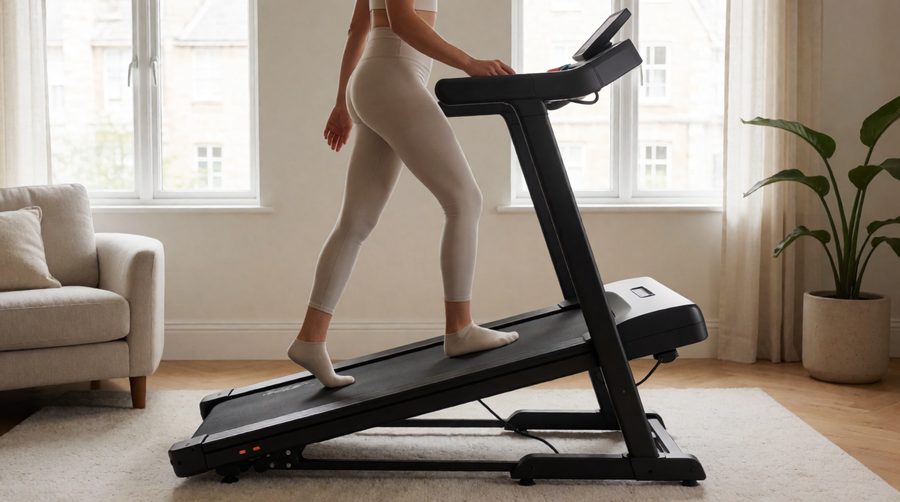
A walking pad is a slim walking treadmill, usually without a handrail, built for slow walking at home or under a standing desk. Most run completely flat. An auto incline model adds a motorised lift at the front, so the belt tilts up at the press of a button. You change the incline on the move, the same way you change the speed, instead of stopping to flip out feet or stack risers under the frame.
That matters because incline is the easiest way to make a walk harder without walking faster. At a desk you can only type comfortably at around 2 to 4 km/h (1.2 to 2.5 mph). Raise the front and the same gentle pace works your legs and lifts your heart rate far more, while staying low impact on your knees and joints.
How a motorised incline works
Under the front of the treadmill sits a second, smaller motor (the lift or incline motor) driving an actuator or lifting arm. Press incline up and it pushes the front roller higher in small steps; press down and it lowers again. The main drive that turns the running belt is separate, which is why a listing can quote 3.0 HP for the belt and still have its own lift.
The lift moves in steps, not directly in percent. One treadmill might offer 9 levels that reach 15%, another 12 that reach 12%. Finer increments make it easier to build up gradually, which is kinder on your calves when you are a beginner.
Dual incline: motor plus feet
Some boards add a manual stage on top of the motor. WIRED's review of the UREVO CyberPad found it reaches 9% under power and 14% when you also change its rear feet. Headline figures like "10%-12%" often mean exactly this, so read the listing for the powered range, not just the top number.
Auto vs manual vs fixed incline
Not every walking pad with incline has a motor. Plenty of listings with incline in the title use fold-out feet, a wedge or a frame that is permanently tilted. Here is how the three types compare.
| Auto (motorised) incline | Manual incline | Fixed incline | |
|---|---|---|---|
| How you change it | Remote control, console or app, while walking | By hand, off the treadmill (feet, knob or riser) | You can't - it is built at an angle |
| Typical range | 0 up to 9-20% | Usually 2-3 settings, e.g. 0/6/12% | Often 3-7% |
| Intervals and programmes | Yes - hills change mid-walk | No | No |
| Weight and parts | Heavier, one more motor | Lighter, simple | Lightest, nothing to fail |
| Best for | Hill workouts, building up gradually | Occasional harder walks on a budget | Desk walking at one steady effort |
If you only want one gentle slope at your desk, a manual or fixed model from our incline walking pad range is lighter and usually cheaper. If you want to start flat, warm up and then climb, a motorised lift is the one to choose.
How much incline do you need?
Incline is quoted as a percentage gradient: the rise divided by the length. A 10% incline rises 10 cm for every metre of travel, an angle of about 5.7 degrees. Some listings quote degrees instead, and a few mix the two, so convert before you compare.
- 5-6% - a gentle hill. Noticeably harder than flat, still easy to type on.
- 9-12% - a proper climb at walking pace, where most incline workouts sit.
- 15-20% - very steep for a walking pad. Good for short hill intervals; hard to hold for a full working session.
Most people do best with a treadmill that reaches 10-15% and steps up in small increments. Very high figures look good on paper, but you may rarely use the top settings while working.
Benefits of walking on an incline
- More work at the same speed - you burn more calories without having to walk faster than you can type.
- Low impact cardio - you stay at walking pace, so there is no pounding through your joints like running.
- Stronger legs - a gradient brings in your glutes, hamstrings and calves far more than flat walking.
- Higher heart rate - a steady climb turns a stroll into real fitness work.
- Less sitting - a treadmill under your desk breaks up long, sedentary working days.
Calories by incline: what the gradient adds
We worked these out with the ACSM walking equation, the standard formula exercise physiologists use to estimate the energy cost of walking at a given speed and gradient. Figures are for a 75 kg adult walking for 30 minutes without holding the handrail. They are estimates, not measurements: your own burn depends on your weight, fitness and stride, and holding on lowers it.
| Incline | Angle | Effort at 4 km/h (METs) | kcal in 30 min at 4 km/h | kcal in 30 min at 5 km/h |
|---|---|---|---|---|
| 0% | 0.0° | 2.9 | 114 | 133 |
| 5% | 2.9° | 4.6 | 182 | 218 |
| 10% | 5.7° | 6.3 | 249 | 302 |
| 12% | 6.8° | 7.0 | 276 | 336 |
| 15% | 8.5° | 8.0 | 317 | 386 |
| 20% | 11.3° | 9.8 | 384 | 471 |
At an easy desk pace, going from flat to 10% roughly doubles the work, and 15% gives close to three times as much, all without speeding up.
That is what you pay for with a motorised incline: a harder workout at a speed you can still type at.
Auto incline walking pads compared
These figures come from the Amazon UK listings for the motorised walking pad treadmill models we track. Where a listing quotes two different maximum weights, we show both, so check with the seller if you are near the limit.
| Model | Max incline | Speed | Motor | Running belt | Weight capacity (as listed) | Treadmill weight | Extras |
|---|---|---|---|---|---|---|---|
| CURSOR FITNESS X8F | 20% auto | up to 12 km/h | 3.0 HP | 40 cm wide | 136-180 kg (listing varies) | 25.3 kg | Handrail, remote, LED display |
| Acezoe P30 | 15% auto | 1-12 km/h | 3.0 HP | 42 x 110 cm | 136 kg | - | Folding handlebar, Bluetooth FITSHOW app, speaker |
| MERACH MR-T25B2 Heavy Duty | 12% auto | up to 6 km/h | 3.5 HP brushless | 42 cm wide | 159-180 kg (listing varies) | 31 kg | Remote, LED display |
| MERACH MR-T14B1 | 9% auto | 1-6 km/h | 2.5 HP | - | 120-136 kg (listing varies) | 25 kg | Remote, Bluetooth app, no assembly |
2-in-1 treadmills with a handrail
The foldable CURSOR and Acezoe models fold their handle down for under desk walking and raise it for running at up to 12 km/h (7.5 mph). That makes them the most versatile here, at the cost of size and weight.
- CURSOR FITNESS X8F - the steepest in our range at 20%, with 8-point shock absorption and a 7-layer running belt.
- Acezoe P30 - 15% in 9 increments, a 42 x 110 cm belt (longer than the usual 100 cm) and 8 shock absorbers.
See our walking and running pads and models with handles for more of this type.
Walking-only under desk walking pads
The two MERACH treadmills stop at 6 km/h, which is plenty for desk walking, and arrive ready to use.
- MERACH MR-T25B2 Heavy Duty - 0-12% from the remote, a 3.5 HP brushless motor, a 42 cm belt and a 6-layer cushioned surface.
- MERACH MR-T14B1 - a more compact walking pad at 124 x 53 x 16.5 cm with 9% incline, work, leisure and fast walk modes and the MERACH app.
The Heavy Duty model's wider belt and higher rating make it one to compare with our pads for heavier users.
Other motorised models UK shoppers compare
Three more names come up again and again in UK reviews. These are sold direct by the brands as well as through Amazon, and their figures come from the makers' own pages or published tests.
DeerRun Z10
A smart walking pad with 12% auto incline over 12 levels, a 1-6 km/h speed range, a 136 kg weight capacity and a brushless motor DeerRun rates at 45 dB. It works with the free PitPat app, and DeerRun has a UK showroom in Oldbury, West Midlands.
UREVO CyberPad
The CyberPad reaches 9% under power and 14% with its rear feet adjusted, tops out at 4 mph and is controlled by a Bluetooth remote and app. WIRED liked the stability but found it too tall to slide under furniture. UREVO's Strol 2S Pro, a 2-in-1 treadmill, reached 9% and 7.6 mph in the same tests.
WalkingPad G5i
WalkingPad (the Kingsmith brand) is better known for flat folding pads, but the G5i is a proper incline treadmill: 18% adjustable incline across 25 levels, 1-10 mph, 136 kg, a 130 x 50 cm belt and a 2-year warranty on the motor, controller, frame and display. In October 2026 WalkingPad UK was including a 12-month Kinomap membership with it.
How to choose an auto incline treadmill
Maximum incline and steps
Check the powered range, not the headline. Then look at how many steps it has: 9 to 12 incline levels lets you climb gradually.
Speed range
Walking-only pads usually top out at 6 km/h (about 3.7 mph). If you want running too, pick a 2-in-1 treadmill with a handrail that unlocks 10-12 km/h.
Weight capacity
The lift raises the whole frame with you on it, so the weight rating matters more here than on a flat walking pad. Pick one rated comfortably above your weight, and be wary where a listing gives different figures in different places.
Motor
For the belt, a continuous rating matters more than "peak HP", which many brands quote. A brushless motor is usually quieter and runs cooler. For the incline, look at reviews for how smoothly the lift moves.
Running belt and cushioning
Standard belts are around 38-40 cm wide and 100 cm long. A wider belt feels safer when you are looking at a screen, and taller walkers should look for 110 cm or more, or browse our wide walking pads. Shock absorption and a multi-layer belt make long sessions kinder on your joints.
Noise
The incline lift makes its own whirr while it moves, though only for a few seconds at a time. Treat very low dB claims with care - 25 dB is quieter than a whisper, which is unlikely for any treadmill. If you take calls while you walk, our quiet walking pads have the lowest noise ratings in our range.
Remote control, display and app
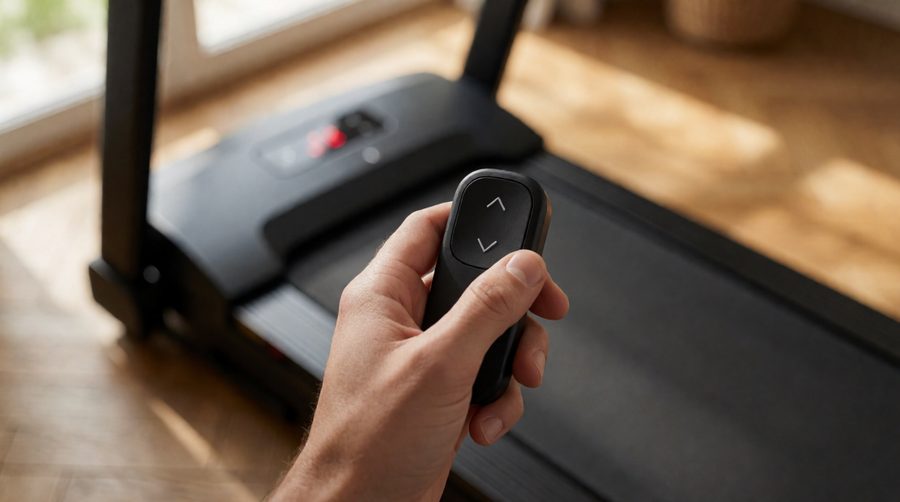
A remote control is the most useful: you change speed and incline with one hand while you type with the other. Check the LED display shows speed, time, distance and calories at a glance. A smart walking pad adds Bluetooth and an app to log steps and run hill programmes.
- MERACH app - MERACH models
- FITSHOW - Acezoe P30
- PitPat - DeerRun
- Kinomap and KS Fit - WalkingPad G5i
Size, storage and small spaces
The lift frame makes these heavier and taller than a flat model - the four in our table weigh 25-31 kg where listed. Most are foldable or low enough to roll on transport wheels under a bed or sofa, but check the folded height against your furniture. For a small space, compare our foldable walking pads.
Warranty
A second motor is one more part that can fail. A 1-year warranty is normal on Amazon listings; brands that sell direct sometimes give 2 years.
Using one under a standing desk
An auto incline desk walking pad works well in a home office if you set it up for it. The frame raises you by 15-20 cm, and the incline lifts your feet a little more, so check your standing desk goes high enough for your elbows to sit at about 90 degrees. Most people type comfortably at up to 5-8% and keep steeper settings for breaks, calls or a focused workout. Our under desk treadmills include the slimmest frames if desk height is an issue.
- Start each session flat and slow, then add incline one step at a time.
- Use the remote rather than leaning down to the console.
- Bring the incline back to 0 before you stop, so the next start is easy.
- Step off and stretch every hour or so, even on the treadmill.
Doing 12-3-30 at home
The routine - 12% incline, 3 mph, 30 minutes - was shared by Lauren Giraldo on YouTube in 2019 and went viral on TikTok a year later. She picked 12% because that was the highest setting on her gym treadmill. By our calculation above, it burns around 325 kcal in 30 minutes for a 75 kg person.
To do it at home you need a powered range that reaches 12% and a top speed of at least 4.8 km/h. Build up to it:
- Start at 5-6% for 20 minutes.
- Add one step of incline every few sessions.
- Go to the full 30 minutes once it feels steady.
- If your treadmill tops out at 9% or 10%, walk a little longer instead.
Safety on an incline
- Clip the safety key to your clothing, so the treadmill stops if you drift off the back.
- Start at 0% and the lowest speed; never step onto a moving, raised treadmill.
- A walking pad treadmill without a handle is for steady walking. For steep intervals or jogging, use a model with a handrail.
- Keep children and pets away from the moving parts and the lift underneath.
- Plug straight into a wall socket rather than an extension lead, unless the manual says otherwise.
- Check for recalls. In April 2026 the US Consumer Product Safety Commission told owners to stop using Sperax walking pads and treadmills over fall, burn and fire risks. UK recalls are listed on the gov.uk product safety alerts page and by Electrical Safety First.
If you have a heart, joint or balance condition, or have not exercised for a while, speak to your GP before starting steep incline walking.
Looking after the lift and belt
- Lower the incline to 0% before folding, moving or storing the treadmill.
- Keep the floor under the front clear - the lift needs room to move.
- Lubricate the belt as the manual says, usually with silicone oil every few months.
- Re-centre the belt if it drifts to one side; it tends to show up first on an incline.
- Put it on a mat to cut vibration and protect a wooden floor or carpet. Our walking pad mats come in the right sizes.
Who should buy one?
Choose a motorised incline if you already walk at your desk and want more from the same time, if you like hill walking and want to train for it indoors, or if you plan to follow incline routines. The NHS physical activity guidelines recommend at least 150 minutes of moderate activity a week and less time sitting, and brisk or uphill walking counts towards that. The NHS walking for health guide has more on building a walking habit.
Choose something simpler if you only want to add steps while you work. A flat model from our cheap walking pads or a compact walking pad from our slim range is lighter, quieter and costs less.
FAQs
Is auto incline worth it on a walking pad?
Yes, if you will use it. It makes a slow walk much harder, lets you change the hill mid-session and runs incline programmes. If you only ever walk flat or at one slope, a cheaper manual or fixed model does the same job.
What is the difference between auto incline and manual incline?
Auto incline uses a motor, so you raise and lower the treadmill with a remote, console or app while walking. Manual incline is set by hand before you start, usually with fold-out feet or a knob.
Can you use it under a desk?
Yes. Most slide under a standing desk. Raise the desk a little to allow for the frame and the incline, and keep the steepest settings for when you are not typing.
How steep is 12% incline?
12% means the belt rises 12 cm for every metre, an angle of about 6.8 degrees. At walking pace it feels like a steady hill and takes roughly two to three times the effort of flat walking.
Can you run on an incline walking pad?
Only on 2-in-1 models with a handrail and a higher top speed, such as the 12 km/h CURSOR X8F and Acezoe P30. Walking-only models like the MERACH pads stop at 6 km/h.
Is a motorised walking pad treadmill louder?
The main drive sounds much the same as on a flat model. The lift adds a short whirr each time the incline changes, then goes quiet. A mat underneath helps with vibration, especially upstairs.